Guest expectations have changed, and hotels feel it every day.
Communication no longer ends at booking confirmation or check-in. In practice, it matters most during the stay; when guests need quick answers, timely updates, or assistance without picking up a phone or walking to the front desk.
This shift has turned in-stay communication into a defining part of the guest experience. It also exposes a growing gap between hotels relying on outdated workflows and those using modern, integrated systems built for how guests and staff actually operate today.
At the center of that shift is modern guest messaging, especially two-way SMS; and how deeply it is embedded into hotel operations.
In-Stay Communication is Where Guest Experience is Won or Lost
Pre-arrival emails still matter. They set expectations, reduce friction, and help guests arrive prepared.
But once a guest is on property, the dynamics change completely.
During the stay, communication becomes:
- Immediate
- Contextual
- Time-sensitive
- Operationally critical
A late arrival question, a request for towels, a Wi-Fi issue, or a safety update cannot wait for the next shift or a returned voicemail. Delays feel amplified because they interrupt the guest’s experience in real time.
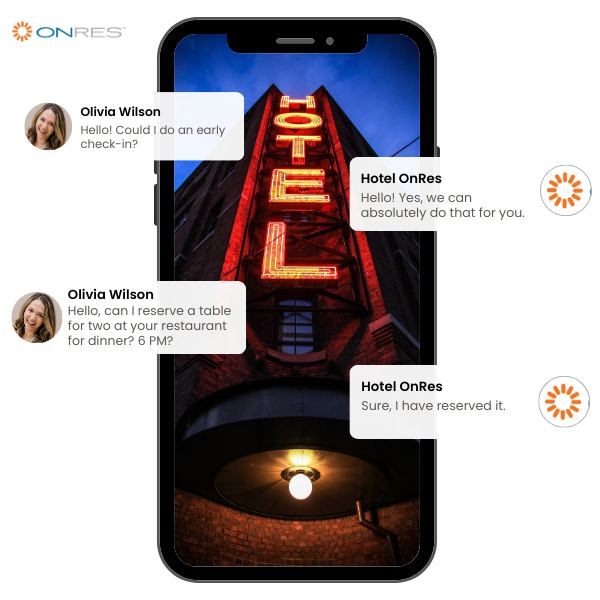
Hotels that rely primarily on phone calls and in-person interactions often struggle here. Phone calls pull staff away from guests physically present, create bottlenecks during peak hours, and assume the guest wants to talk, which many do not.
This is where modern guest messaging fundamentally changes the equation.
What Guest Messaging Actually Means Today
Guest messaging is often misunderstood as automated emails or basic notifications sent before arrival.
That definition is outdated.
Today, guest messaging means real-time, two-way communication that is directly tied to the guest’s stay and reservation. It means guests can reach the hotel the same way they communicate with airlines, delivery services, and other modern service providers — quickly, quietly, and without friction.
In OnRes, Guest Messaging is not a bolt-on tool or a disconnected inbox. It is built directly into the PMS and reservation workflow.
That distinction matters more than most hotels realize.
Because messaging is native to OnRes:
- Conversations are automatically tied to the reservation
- Staff always see context – who the guest is, when they arrive, where they are in their stay
- Communication history is preserved and shared across shifts
- Nothing lives in a separate app, inbox, or staff member’s phone
This is not messaging layered on top of operations. It is messaging embedded inside them.
For full setup and details on automated emails, two-way SMS chat (chat-like interface with replies forwarded to staff phones), and broadcast messaging, see our Guest Emails & Messaging Guide (Sections 6, 7, 8).
Why Two-Way SMS Has Become the Preferred Channel
Guests overwhelmingly prefer texting to calling.
Phone calls feel intrusive, slow, and unnecessary for simple requests. Texting feels natural, discreet, and efficient, especially when guests are in their room, arriving late, or communicating outside traditional front desk hours.
Two-way SMS allows guests to:
- Ask questions without leaving their room
- Request towels, housekeeping, or assistance
- Report issues discreetly
- Receive confirmations and updates in writing
For hotels, SMS dramatically improves operational flow. Staff can manage multiple conversations at once, respond during natural workflow breaks, and prioritize urgent requests without constant interruption.
This is particularly valuable for:
- Independent hotels
- Owner-operators
- Properties without 24/7 front desk coverage
- Lean teams balancing cleaning, maintenance, and guest support
Better communication does not require more staff. It requires better systems.
Broadcast Messaging: When Speed and Safety Matter Most
One of the most powerful, and most underestimated capabilities of modern guest messaging is broadcast messaging.
Broadcast messaging allows hotels to send a single message to all guests currently checked in. This is not a marketing feature. It is an operational and safety tool.
Use cases include:
- Emergency notifications
- Safety alerts
- Weather warnings
- Power or water interruptions
- Property-wide operational updates
A real-world example illustrates why this matters.
A coastal property near Tofino requested broadcast SMS capability specifically to notify guests during tsunami alerts. Sirens may not be heard inside rooms, and staff cannot contact guests individually in time.
Broadcast SMS ensures that:
- All in-house guests receive alerts instantly
- Messages reach guests regardless of location on property
- Critical information is delivered clearly and directly
This is where guest messaging becomes more than convenience. It becomes responsibility.
Clear, Documented Communication Improves Operations
Another advantage of SMS-based communication is documentation.
Unlike phone calls, SMS creates a written record. Messages are timestamped, stored, and tied directly to the guest and reservation.
This improves:
- Shift handovers
- Accountability
- Consistency of service
- Staff confidence when responding to follow-ups
When messaging is native to the PMS, staff do not need to guess what was said, promised, or resolved. The full conversation is visible in context.
Why Native Guest Messaging Beats Bolt-On Tools
Many hotels attempt to solve communication gaps with third-party messaging tools. These systems often look appealing on the surface but introduce new problems operationally.
Bolt-on tools typically:
- Live outside the PMS
- Require manual syncing
- Fragment guest communication
- Depend on individual staff logins or devices
OnRes takes a fundamentally different approach.
Guest Messaging in OnRes is native. It shares the same data, logic, and workflow as reservations, contactless check-in, and upselling.
This means:
- No duplicated data
- No integration gaps
- No context switching for staff
- No loss of communication history
Messaging works because it is part of the system, not stitched onto it.
Guest Messaging as Part of a Broader Guest Engagement Strategy
Guest Messaging in OnRes is designed to complement a broader set of guest engagement tools, including native contactless check-in and upselling.
On its own, messaging improves responsiveness. Combined with contactless workflows and targeted upsell opportunities (e.g., pre-check-in SMS triggers for room upgrades or early check-in, late check-out requests during check-out, with revenue tracked in the Upsell Report), it becomes part of a cohesive guest engagement system that supports guests throughout their stay.
Together, these tools help hotels:
- Communicate clearly with guests
- Reduce reliance on a constantly staffed front desk
- Manage guest needs efficiently from arrival through departure
- Unlock additional revenue without adding complexity
For owner-operators and lean teams, this is especially important. Staff are often cleaning rooms, maintaining the property, or managing operations remotely.
Tools like two-way SMS, contactless check-in, and native upselling allow hotels to stay responsive and supportive without requiring staff to be physically present at the front desk at all times — and without adding operational overhead.
For details on how contactless flows integrate with messaging for upsells and notifications, see our Contactless Check-in & Upselling Guide.
Why OnRes Sets the Standard
What separates OnRes from competitors is not a single feature. It is the architecture.
Guest Messaging, Contactless Check-In, and Upselling are not separate modules bolted together. They are native components of a single platform designed for real hotel operations.
This results in:
- Cleaner workflows
- Better staff adoption
- Stronger guest experiences
- Lower operational friction
Hotels do not need more tools. They need systems that work together.
The Bottom Line
Guest messaging is no longer a “nice to have.” It is a baseline expectation for modern hotel operations.
Hotels that implement it well:
- Resolve issues faster
- Reduce staff stress
- Improve guest satisfaction
- Operate more safely and efficiently
Hotels that implement it natively, as part of an integrated guest engagement platform, gain a clear competitive advantage.
That is where OnRes stands apart, and why it is setting the standard for modern, independent hotel operations.
Ready to see native Guest Messaging in action for your property? Explore the full setup in the guides above or contact us for a quick overview – no pressure, just practical details.
Ready to upgrade your in-stay communication and see real impact on satisfaction, efficiency, and revenue? OnRes Guest Messaging is designed for properties like yours.
(Sections 6, 7, 8); or contact us for a quick demo tailored to your operation.
